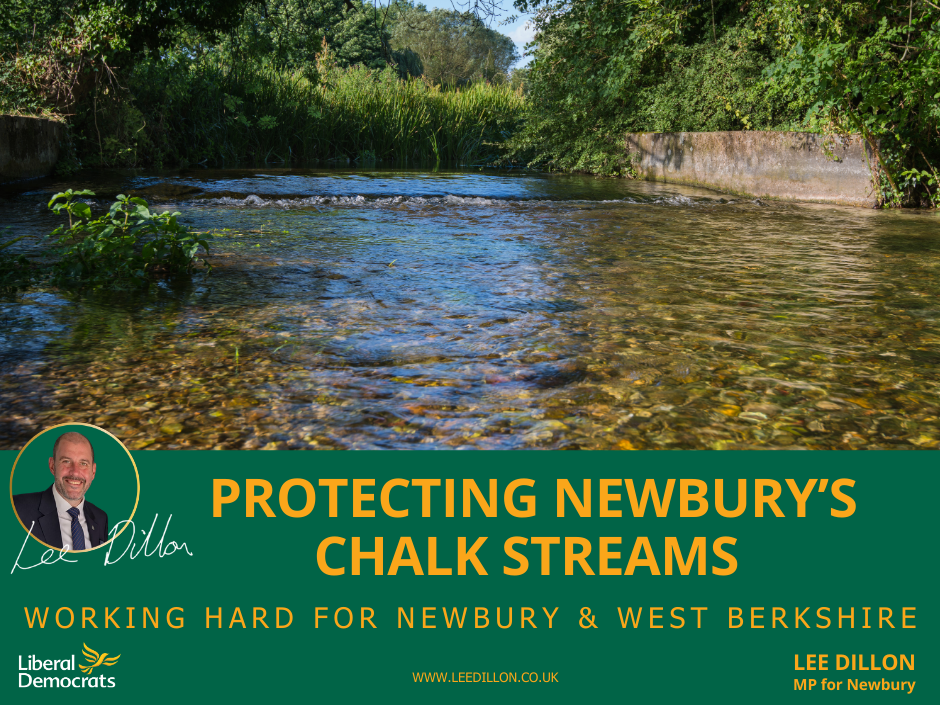
_edited.png)
Tackling Ongoing Sewage Network Issues in the Lambourn Valley
Across Newbury and West Berkshire, we are extremely fortunate to have so many dedicated local groups stepping up to protect our environment. One brilliant example is the Lambourn Valley Flood Forum (LVFF), who I met last week to discuss the sustained and unacceptable sewage issues affecting the Upper Lambourn Valley.
What is happening in Lambourn is not caused by standard blockages, but groundwater infiltration: when the water level rises in the chalk valley, the outdated sewer network effectively becomes a ‘buried river,’ pipes are overwhelmed with groundwater, and sewage is forced up through manholes.
Persistent surges are leading to sewage streaming down Newbury Street, rolling onto the doorsteps of homes, the fronts of local businesses, and into the River Lambourn – this is symptomatic of a system that puts profits over West Berkshire residents and our treasured local environment.
Residents were initially told that this was a one-in-a-century event, it’s now the norm.
Even in Upper Lambourn, one of our many quiet and picturesque villages, residents have experienced numerous instances of groundwater infiltration and as I write this, a ‘storm overflow’ is being discharged into the Winterbourne Stream and has done so for 36 hours straight.
At the local level, there has been some progress. Thames Water (TW) has installed over 1.5km of pipelining and fitted pressure plates on manhole covers to limit surges. Local engineers are committed to finding technical solutions, and the LVFF and I will continue to work collaboratively with local officers to secure practical, long-term improvements to the local network.
But for residents who are still sweeping sewage off their streets and landowners clearing out ditches to minimise groundwater however they can, this is not on. Crucially, Thames Water hasn’t provided full hydraulic modelling for the Lambourn network, clarity on its tolerance levels, or a clear timeline for further investigations.
So, following my letter to Philip Duffy, CEO of Environment Agency (EA), urging them to take stronger action on the non-compliance of storm overflows, the EA have instructed TW to specifically lay out how they will address systemic groundwater infiltration problems through a Groundwater Impacted System Management Plan. At the same time, the EA is going to carry out additional ecological monitoring of the River Lambourn next month.
This is positive, but the key is not just to lay out further plans or monitoring, but concrete commitments that will address the core problem for local residents.
In May, I plan on joining the LVFF’s quarterly meeting with West Berkshire Council, EA, and TW to push for clear action in West Berkshire while joining my Liberal Democrat colleagues in Parliament to repeat calls for a fundamental change in the ownership model of TW.